service
Custom product configurator development
We build product configurators around your real product logic — options, constraints, pricing and output — for products too complex for off-the-shelf SaaS configurator platforms.
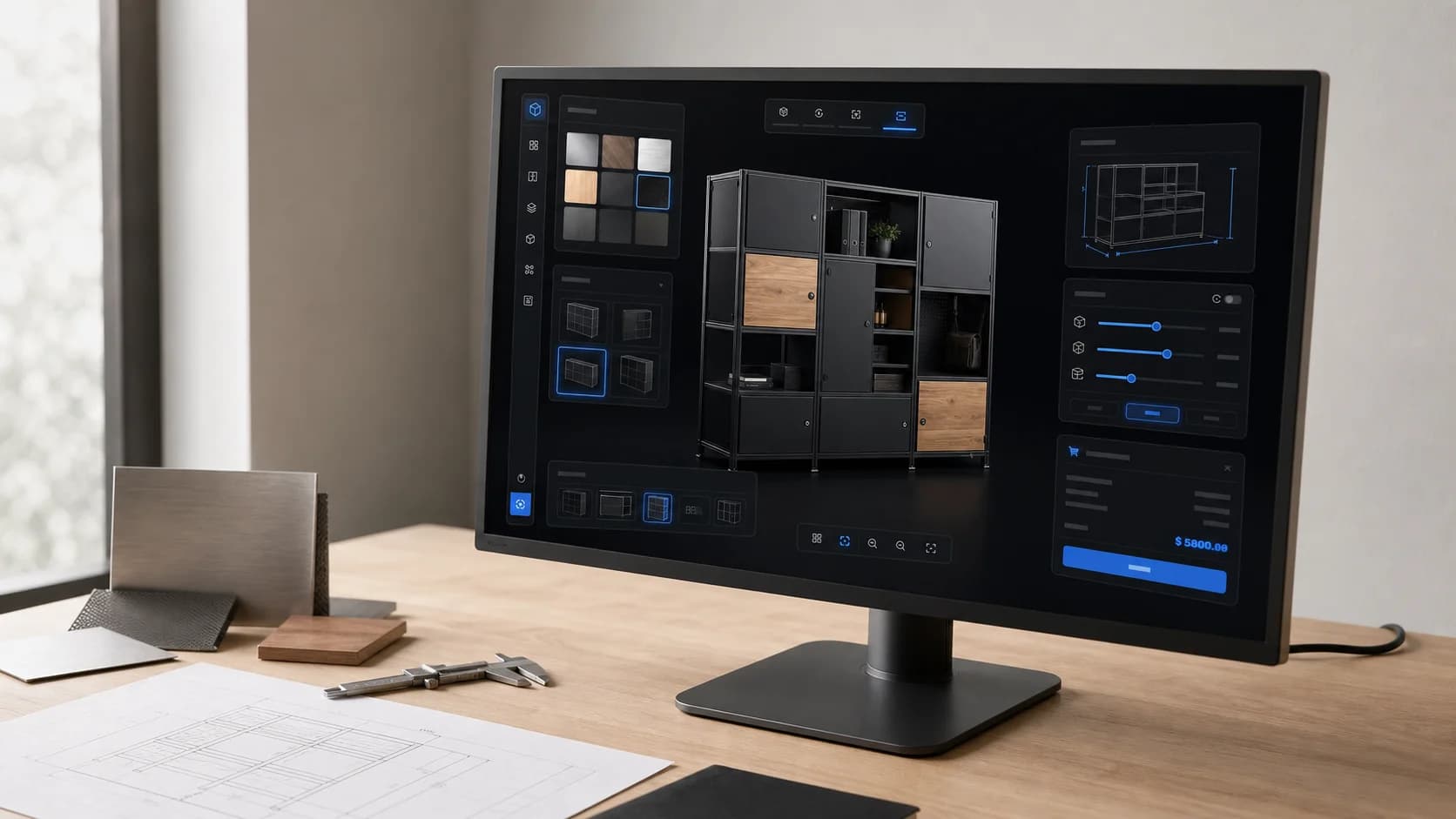
what it is
A custom 3D configurator product experience lets your buyer assemble their version of your product — dimensions, materials, options — while a rules engine keeps every combination valid, priced and manufacturable — the difference between generic product configurator software — an off-the-shelf online product configurator, or a generic product configurator for website embedding, — and a system built for your catalog. Built custom, it encodes your actual engineering constraints and integrates with the systems you run.
who it’s for
Manufacturers and B2B companies with configurable products: furniture, building products, industrial equipment, machinery — anywhere the number of valid combinations outgrows a static catalog or a platform template.
how it works
Map the product logic
Options, exclusions, pricing drivers and output requirements captured in a mapping session with your product team.
Design the buying flow
A configuration UX designed for your buyer — visual where it helps, spec-driven where it matters.
Build & integrate
Rules engine, 3D or 2D front end, quote output and ERP/CPQ/e-commerce integration, shipped in tiers.
key takeaways
- —Custom rules engine — your constraints, not a template ceiling
- —3D or rules-based UI designed for your buyers
- —Quote and BOM output that flows into your ERP or CPQ
- —Tiered fixed-price scope; you own the code
When the platform isn't enough
SaaS configurator platforms cover the common case: visual options, standard pricing, a checkout. They run out of road when your product logic is genuinely complex — engineering constraints between options, contract or region pricing, manufacturable BOM output, deep ERP integration. The signal is always the same: your team starts maintaining spreadsheets and workarounds beside the platform to cover what it cannot express. A custom configurator embeds your real rules and connects to your actual systems, with an interface designed for your brand and your buyers rather than a template shared with every other platform customer.
Built from your product logic
Every build starts with the rules, not the visuals. Which options exclude each other. How a dimension change moves the price. What a valid, buildable specification looks like to your production team. We capture this in a structured mapping session with the people who know the product — engineering, sales, production — and encode it in a constraint engine that keeps every configuration valid by construction. The visual layer sits on top: real-time 3D where seeing the product sells it, a clean spec-driven interface where the decision is technical.
Integration is the point
A configurator that ends at a contact form wastes most of its value. Ours output a priced, structured specification that flows into the systems that need it: quote generation with your pricing rules applied, BOM output for production, order injection into your ERP or e-commerce stack. Buyers get instant answers; your team stops re-keying configurations by hand.
What a build includes
A rules and constraint engine encoding your product logic; the configuration front end; pricing and quote generation; and the integration layer into your ERP, CPQ or e-commerce systems. Where 3D earns its place we build or adapt product assets; where it doesn't, we don't charge you for spectacle. The first release ships your highest-value product lines end to end; extension phases add product families, markets and languages.
Typical integrations
Most configurator projects connect to two or three systems, not ten. The usual set: an ERP (SAP, NetSuite, Dynamics, Odoo) for items, prices and orders; a CRM or CPQ (Salesforce, HubSpot) for quotes and pipeline; an e-commerce layer (Shopify, Magento) where the configuration ends in a checkout — and, for 3D builds, your CAD exports as the source for web-ready product assets. We integrate through your systems' APIs with a thin, documented adapter layer, so a future ERP migration means rewiring one adapter rather than rebuilding the configurator.
Priced for the work
Engagements typically run $50,000–$200,000 depending on rules complexity, 3D asset needs and integration depth. The mapping session produces a fixed scope and price before build begins — you know the number before the first line of code. You own the result: source, documentation, deployment, and the freedom to extend it with any team.
questions
What is a 3D product configurator?+
A 3D product configurator is an interactive tool that lets a buyer assemble their version of your product visually — choosing dimensions, materials, colors and options — while the tool renders the result in real time and keeps every combination valid. Behind the visual layer sits a rules engine: it knows which options exclude each other, how each choice affects price, and what the resulting bill of materials is. Configurators are standard practice for furniture, industrial equipment, building products and vehicles, where the number of valid combinations is too large for a static catalog. The output is a priced, buildable specification that can flow directly into your quoting or order system.
When is an off-the-shelf configurator platform not enough?+
SaaS configurator platforms are built for the common case: visual options, standard pricing, e-commerce checkout. They run out of road when your product logic is genuinely complex — engineering constraints between options, pricing that depends on contracts or regions, output that must generate a manufacturable BOM, or integration into an ERP your business runs on. At that point teams start maintaining workarounds outside the platform, which is the signal to build. A custom configurator embeds your real product rules, integrates with your actual systems, and presents it in an interface designed for your brand and your buyers rather than a template shared with every other platform customer.
How much does a custom product configurator cost?+
Custom configurator projects here typically run from $50,000 for a rules-based configurator with quote output, up to $200,000 and beyond for full 3D configuration with real-time rendering, complex constraint logic and deep ERP/CPQ integration. The main cost drivers are the complexity of the product rules, whether 3D assets exist or must be produced, and how many systems the configurator must read from and write to. We scope in tiers so the first release ships a working core — the highest-value product lines with essential rules — and later phases extend coverage. Every engagement starts with a mapping session that produces a fixed scope and price before build begins.
related services