service
Knowledge base and help center design
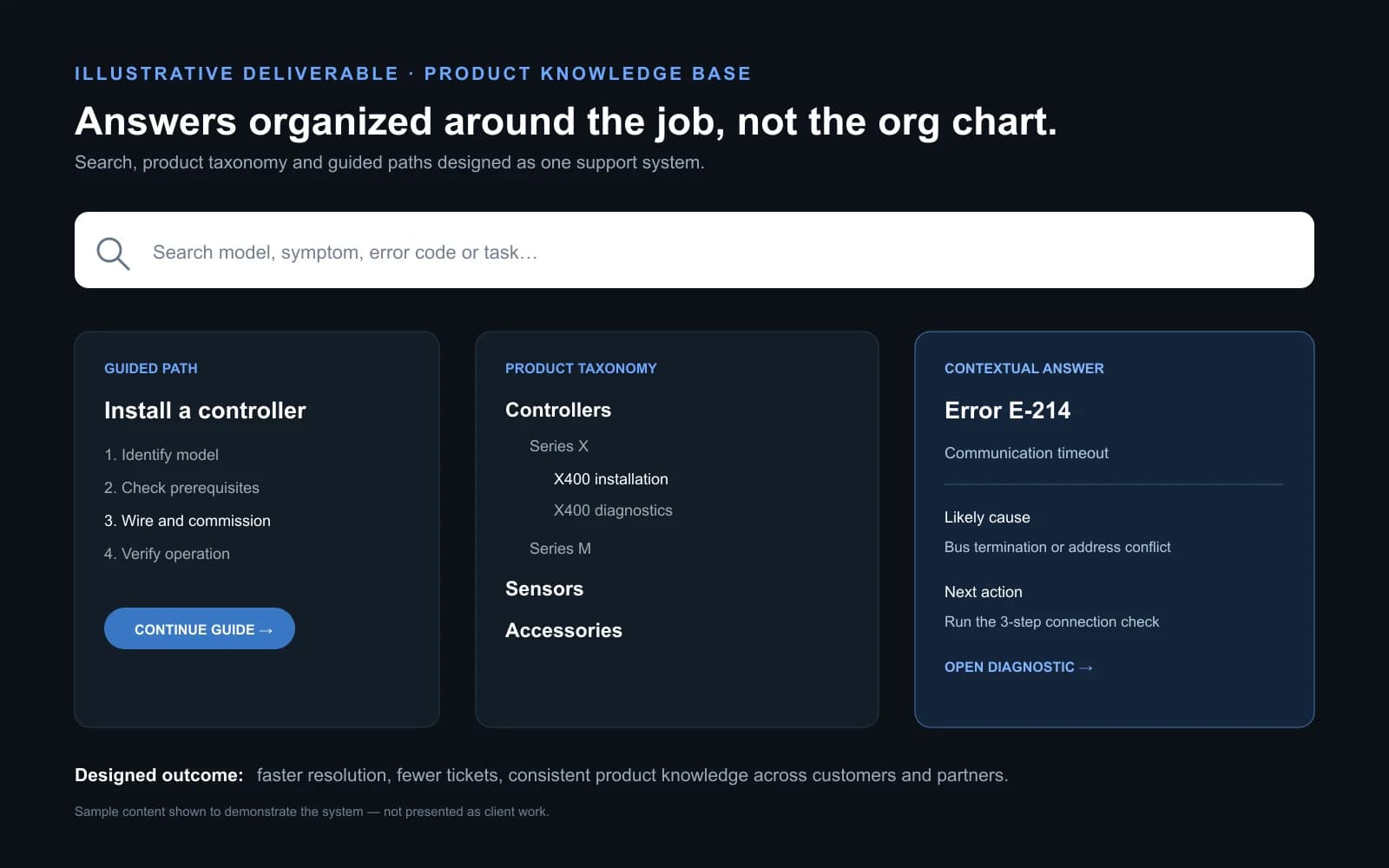
We design knowledge bases and help centers that answer questions before they become tickets — information architecture, search and content templates built from your real support data.
what it is
A knowledge base is the searchable, self-service library of answers about your product. Designed well, it deflects support volume, feeds the AI assistants your customers already ask, and turns your product knowledge into a durable asset.
who it’s for
Support and product leaders at companies with complex products — where setup, configuration and troubleshooting questions repeat, and every deflected ticket saves real money.
how it works
Mine the questions
Support tickets and search logs reveal the real question inventory — we start from evidence, not assumption.
Design the architecture
Task-based categories, one canonical article per question, search with your customers’ vocabulary.
Template & measure
Article templates, authoring guidelines, and the metrics that show where the structure fails.
key takeaways
- —Architecture from real ticket and search data — not assumptions
- —One canonical article per question, two routes to everything
- —Deflection metrics designed in from day one
- —Structured for AI assistants as well as human search
Structured around questions, not org charts
A knowledge base fails when it mirrors your internal structure instead of your customers' questions. We start from support ticket data and search logs to find the real question inventory, then group it into task-based categories — getting started, configuration, troubleshooting, billing — with one canonical article per question. Navigation offers two routes to everything: browse by category, and search with synonyms mapped to the vocabulary your customers actually use.
Deflection you can measure
The business case is ticket deflection: every question answered by an article is a question your support team does not handle manually. We design the measurement in from the start — article views, searches that return nothing, deflection against ticket categories — so the structure improves from evidence instead of opinion. The empty search-results report alone tells you exactly what to write next.
Built for the AI-answer era
Your customers increasingly ask AI assistants before they ask you. A well-structured knowledge base — clean headings, one answer per page, honest question-phrased titles — is exactly the source material those systems cite. Structure your product knowledge properly and it works twice: once on your help center, once in every AI answer about your product.
From help center to product academy
The same discipline extends to onboarding academies and training platforms: sequenced learning paths, progress tracking, certification steps. For products with dealers and partners, the academy is often what makes the channel productive — and it shares the information architecture with the help center rather than duplicating it.
Priced for the work
Design engagements typically run $25,000–$120,000 depending on content volume and whether we design the system, build it, or both. Mapping session first, fixed scope, measurable outcome.
questions
How do you structure a knowledge base?+
A knowledge base is structured around the questions users actually bring, not around your org chart. We start from support ticket data and search logs to find the real question inventory, then group it into task-based categories — getting started, configuration, troubleshooting, billing — with one canonical article per question. Each article follows a consistent template: the answer first, then steps, then edge cases. Navigation offers two routes to everything: browse by category and search with synonyms mapped to your customers' vocabulary. A good structure is measured, not assumed — article views, search terms that return nothing, and ticket deflection tell you where the structure is failing and what to write next.
What is a knowledge base, with an example?+
A knowledge base is a searchable, self-service library of answers about your product: how to set it up, how to use each feature, what to do when something fails. A familiar example is the help center behind any major software product — categorized articles, a search bar, step-by-step guides with screenshots. For manufacturers the same pattern covers installation guides, maintenance schedules, spec sheets and troubleshooting trees. The business case is ticket deflection: every question answered by an article is a question your support team does not handle manually. For complex products, a well-designed knowledge base also feeds AI assistants and search engines, which increasingly answer your customers' questions whether you provide the source material or not.
related services